Showing posts with label bones. Show all posts

Sunday, March 2, 2014

The Soap-Maker of Correggio

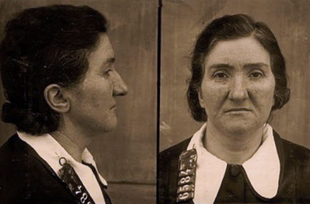
Leonarda Cianciulli was an Italian murderess best known for having turned her victims into teacakes and soap.  The teacakes were served to the community and her own family.  The soap was given as gifts.


Miss Cianciulli was born in Montello, Province of Avellino in Southern Italy on April 14, 1894.  Her childhood was marred by personal struggle, and after two failed suicide attempts, she married a man without her family's blessings.  Going against their wishes, she felt, would haunt her the rest of her life.

A series of unfortunate accidents, miscarriages, and ten deceased children culminated in the murder of three townswomen in Correggio where her husband and she had finally settled.  She was considered a pillar of the community and was sought out by local women as a fortuneteller, which gave her an incredible ability to manipulate her chosen victims.

The murders started in 1939.

Faustina Setti--  Miss Setti was the first of her victims, a fifty year old spinster who paid 30,000 lire for Miss Cianciulli's help in finding a husband.  After claiming she had located a suitable match, Leonarda instructed her to write letters indicating she was fine for her family members.  She was to tell no one of the marriage and mail the letters upon arrival in her future husband's village.

When Faustina came for a final visit to say farewell, Leonarda drugged her with a glass of wine and used an ax to cut her victim's body into nine pieces while collecting the blood in a basin.  The following is an account of the incident from Leonarda's personal memoir, An Embittered Soul's Confessions.

I threw the pieces into a pot, added seven kilos of caustic soda, which I had bought to make soap, and stirred the whole mixture until the pieces dissolved in a thick, dark mush that I poured into several buckets and emptied in a nearby septic tank. As for the blood in the basin, I waited until it had coagulated, dried it in the oven, ground it and mixed it with flour, sugar, chocolate, milk and eggs, as well as a bit of margarine, kneading all the ingredients together. I made lots of crunchy tea cakes and served them to the ladies who came to visit, though Giuseppe and I also ate them.

Francesca Soavi--   Francesca, the second victim, paid 3,000 lire to have Miss Cianciulli find a job for her.  Cianciulli claimed she had a found a position for the woman at an all girl's school and that Francesca should write letters to her family saying all was well that were only to be mailed when she arrived in her new home.  Like the first victim, Miss Soavi was drugged with a glass of wine and hacked to pieces, her parts being made into cakes and soap.  The murder took place on September 5, 1940.

Virginia Cacioppo--  The third and final victim was said to have paid 50,000 lire when Leonarda supposedly found her a secretarial position for an impresario in Florence.  The scheme went much the same as the previous murders.  Letters were to be written to her family but only mailed after her move was completed.  No one was to be told until then.  During her farewell visit with Leonarda, Virginia was drugged, cut into pieces and her body disposed of.

This is what Cianciulli had to say about her final victim.
She ended up in the pot, like the other two...her flesh was fat and white, when it had melted I added a bottle of cologne, and after a long time on the boil I was able to make some most acceptable creamy soap. I gave bars to neighbours and acquaintances. The cakes, too, were better: that woman was really sweet.

Leonarda was eventually caught and charged with the crimes when Miss Cacioppo's sister-in-law became suspicious over her sudden disappearance and had been last seen entering Cianciulli's home.  After being arrested, she confessed to the murders and provided vivid details, even going so far as to correct the official account while on the witness stand.

She served thirty years in prison and a further three in a criminal asylum where she died on October 15, 1970 of cerebral apoplexy.

Saturday, February 15, 2014

The X Tombs

I recently watched a fascinating documentary on a PBS station regarding the discovery and investigation of the X Tombs in Rome.  Discovered in 2003, these tombs are a series of chambers found in the X quadrant of the Catacombs of St Marcellinus and St Peter along Via Casilina in Rome, Italy.  They contain thousands of male and female corpses all compacted together and neatly ordered.  Archaeologists have yet to determine their identity or even their cultural origins, and the excavation has been ongoing since 2005.

Carbon dating indicates the individuals died in waves beginning in the late first century AD and ending in the early third century, but only a handful of clues remain as to their identities and causes of death.  Archaeologists heading up the research, most notably mass grave specialists Dominique Castex and Philippe Blanchard and head archaeologist Raffaella Giulliana, indicate there aren't any signs of physical trauma, ruling out the possibility they were Christian martyrs or soldiers killed in battle.  That leaves disease as a likely culprit.  DNA investigations are ongoing in an attempt to find genetic evidence that may remain locked in the skeletal remains.

What I found most interesting, however, wasn't the mystery of their identities but the manner of their burial.  Many individuals bear similar funerary practices, indicating a certain percentage of the corpses belong to the same cultural group.  The corpses are positioned with their legs outstretched, ankles touching, and their arms flat against their sides.  Their shoulders are tightly compressed which indicates the bodies were bound tightly, and then the individual bundles were covered in plaster.  Traces of powdered amber and gold thread were found inside.  One corpse still wears a black ring around his or her finger.  Gold earrings were also discovered.  All of this attests to the individuals being wealthy.

The bodies were then stacked inside the tombs.  Most were laid out in neat rows and layered one on top of the other, but a few were turned slightly on a precise axis.  According to the documentary, the tombs contained more bodies than would have fit were the bodies still covered in flesh and soft tissue, another indication they were interred in waves.  A group of people were placed inside and allowed to decompose over time before another layer of bodies was added.

In the end, the documentary postulated that the tombs may contain members of the Equities Singulares Augusti, the personal cavalry of the Roman emperor, and their wives.  They would have been comprised of members who hadn't been born in Rome and may have come from Northern Africa.  No one can say for certain, though, and the investigation still continues.  I look forward to following the details.

If you would like to read further, this was a fascinating article that goes into more detail.


Monday, February 3, 2014

Aztec Lord of the Dead


Mictlantecuhtli (meaning Lord of Mictlan) is the chief death god in the Aztec pantheon and is king of Micltan, the lowest and northernmost section of the Underworld where he lives with his wife Mictecacihuatl.  He is depicted as a humanoid figure with either a skull in place of a head or wearing a skull mask.  It's worth mentioning that many of the Aztecan deities are depicted as either having skulls for heads or wearing clothing incorporating the skeleton or bones.  Because of the close nature between life and death, this was considered a sign of fertility, health, and abundance.

Aztecan belief, much like Viking mythology, separates souls into three different categories.  Those who die of natural causes such as old age and disease belong in one category.  The second category contains those who die honorable or heroic deaths; this includes men who die in combat, people who are sacrificed, and (I was pleasantly surprised to learn) women who die in childbirth.  Category three is comprised of those who die of non-heroic deaths.  I haven't found any information on what entails dying a non-heroic death.

As the mythology goes, Quetzalcoatl made an arrangement with Mictlantecuhtli to retrieve the bones of their divine ancestors from the Underworld.  The lord of Mictlan changed his mind, however, and Quetzalcoatl and his twin, Xolotl, were forced to steal them.  Some of the bones were dropped during their escape and shattered.  The various races of mortals were created from these bones, and our imperfections are caused by the broken pieces.

Mictlantecuhtli was often paid homage to by ritual cannibalism.